
SAT/ACT & College Readiness
What SAT or ACT Score Should My Child Aim For at Florida Colleges?
Start with the colleges your child is most interested in. Look up each school’s recent SAT or ACT range, compare it with your child’s current score, and decide what improvement is realistic before scores are due. If you’re also planning for Bright Futures, write down the scholarship score separately. You may be working toward two different targets.

What SAT and ACT scores do Florida colleges report?
The middle 50% runs from the 25th to the 75th percentile of the group a college reports. Check whether the profile covers students who were admitted, students who enrolled, or only those who submitted scores. Use the range as a planning reference alongside grades, course rigor, and the rest of the application.
| University | Published profile | SAT | ACT |
|---|---|---|---|
| University of Florida (UF) | Class of 2030 admits, middle 50% | 1420–1520 | 32–35 |
| Florida State University (FSU) | Fall 2026 admits, middle 50% | 1380–1480 | 31–34 |
| University of Central Florida (UCF) | Fall 2026 admits, published mid-range | 1310–1420 | 28–32 |
| Florida Atlantic University (FAU) | 2026 first-year admits, middle 50% | 1090–1270 | 22–28 |
| University of North Florida (UNF) | Fall 2026 admits, middle 50% | 1090–1280 | 23–29 |
| University of South Florida (USF) | Fall 2026 admits, published mid-range | 1290–1420 | 28–32 |
What if your student is also looking out of state?
| University | Published profile | SAT | ACT |
|---|---|---|---|
| University of Georgia (UGA) | Class of 2030 admits, overall published range | 1360–1500 | 31–34 |
| Auburn University | Fall 2025 enrolled nonresidents, middle 50% | 1280–1370 | 28–32 |
Auburn’s profile covers nonresidents who enrolled, while Georgia reports its overall admitted class. Check each school’s current profile for the term your student plans to enter.
Score ranges checked November 2026.

Use a diagnostic to set a practical target
A full-length, timed diagnostic gives your child a starting score. In the results review, we look at section scores, the types of questions your student missed, and where they ran short on time. Bring your college list so we can compare that baseline with the schools your student is considering and recommend what to work on first.
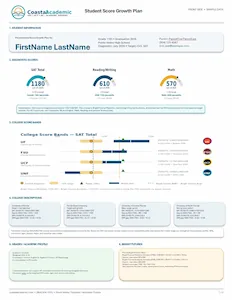
A test percentile compares your student with the test’s reference group. A college score range describes the group in that college’s profile. When choosing a target, compare your child’s score with the college’s range for the same exam. If your child has tried both tests, make that comparison for each one.
Still deciding which exam to take? See how we use practice tests to help students choose between the SAT and ACT.
One student, two score targets
Suppose a student graduating in 2027 earns an official 29 ACT. That meets the Florida Academic Scholars test-score requirement for their class and falls within the published ranges at UCF and USF. If FSU or Georgia is a priority, 31 is a first prep target because it reaches the lower end of those schools’ reported ranges.
Before booking a retake, identify the section most likely to improve and use a recent timed practice test to see whether the target is within reach. Check whether the college superscores and when and how it accepts a new score for your student’s application round. For the scholarship requirements by graduation year, see our Florida Bright Futures SAT and ACT prep guide.

Once your student has a target score, learn how Coastal Academic can help them prepare for the SAT or ACT.
Find your student’s starting point
Request a complimentary full-length SAT or ACT diagnostic from Coastal Academic. We’ll review your student’s score, college goals, and preparation priorities in a 30-minute results consultation.
Request a Complimentary SAT or ACT Diagnostic